Outsourcing
Software Delivery model based on Build Operate Transfer plan

Introduction
Many organizations are currently looking to undergo an operational or digital transformation quickly and at a designated budget. However, they find themselves confronting these rather searing questions:
- How do you go-to-market quickly with the right offering when all you have is a project plan?
- How do you scale up an existing team that is focused on specific core functions for your organization?
- How do you hire and develop a dedicated team with new skillsets that will enable you to achieve your business goals?
- At the same time, how do you retain control over the new team and their deliverables?
When faced with this situation, it’s a good idea for a company to look into hiring a remote team that can drive it closer towards its business objectives faster!
As described in the picture below, there are multiple delivery models for software development that would match your expectations.
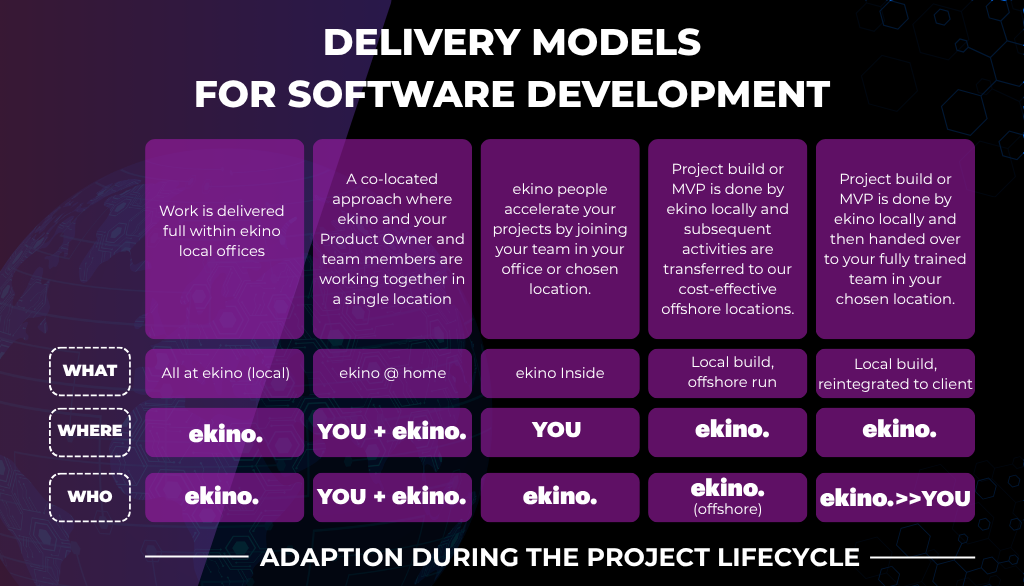
Of course, one size doesn’t fit all. The needs of an organization are determined by its objectives, product or service portfolio, culture, digital maturity and other differentiating factors. Outsourcing also carries drawbacks that need to be carefully considered.
However, if you consider switching to a long-term offshore software development service center, we recommend investing in a B.O.T plan. This article will explain what a B.O.T plan is, what it includes and how it can benefit your outsourcing needs. We’ll also show how ekino Vietnam can support you by implementing B.O.T for your projects.
Why consider outsourcing? Advantages and disadvantages
Before we explore B.O.T plans, it’s important to acknowledge that some organizations are still uncertain about outsourcing their projects.
Let’s consider the wider context: In 2024, the global IT services outsourcing market was valued at $744 billion, which is forecasted to reach $1.2 trillion by 2030. This growth is especially visible in Asia-Pacific, which benefits from competitive costs and a young, digital-fluent population. In particular:
- According to market researcher Mordor Intelligence, Japan’s outsourcing market will see rapid growth over the 2026 – 2031 period, rising from $74 billion in 2026 to $127 billion by 2031 at a CAGR rate of 11.31%.
- Vietnam also demonstrates strong growth. Mordor forecasts the market to double in size within the next 5 years from $2 billion in 2026. Data from Statista also shows that from $856 million in 2026, Vietnam’s total outsourcing revenue will cross $1 billion as early as 2028.
The booming outsourcing/offshoring industry also gives businesses a competitive edge. According to Forbes, strategic use of outsourcing not only provides cost benefit, but gives businesses greater flexibility to adapt to changing market demand, as well as stronger focus on their expertise by offloading repetitive tasks. Leaner business operations have more room to adapt, innovate, and grow.
However, outsourcing also has several drawbacks. For example, while an offshore remote team can deliver high-quality deliverables at a reasonable cost to the company quickly, when you’re sitting in an office, miles apart, trying to focus on your core business functions, hiring and managing such a team can be a challenge. Aligning goals, values, and culture to recruit the offshore team can also be both a time-consuming and legally complicated exercise. In other words, the issue is to outsource offshore but at the same time secure your team asset and know-how for your future success. That’s where Ekino Vietnam comes in! We offer the B.O.T Model to our clients to address their business needs. But before that, we need to explain what B.O.T means.
What is B.O.T?
A B.O.T contract is one where a client organization hires a service provider organization to set-up, run (the operations for the duration of the contract) and transfer the operations to the client organization. The B.O.T organization sets up a turn-key business for its client organization, which is involved in the operations of the business and takes full control from the service provider when the business is ready and working.
B.O.T plan’s 3-phase model
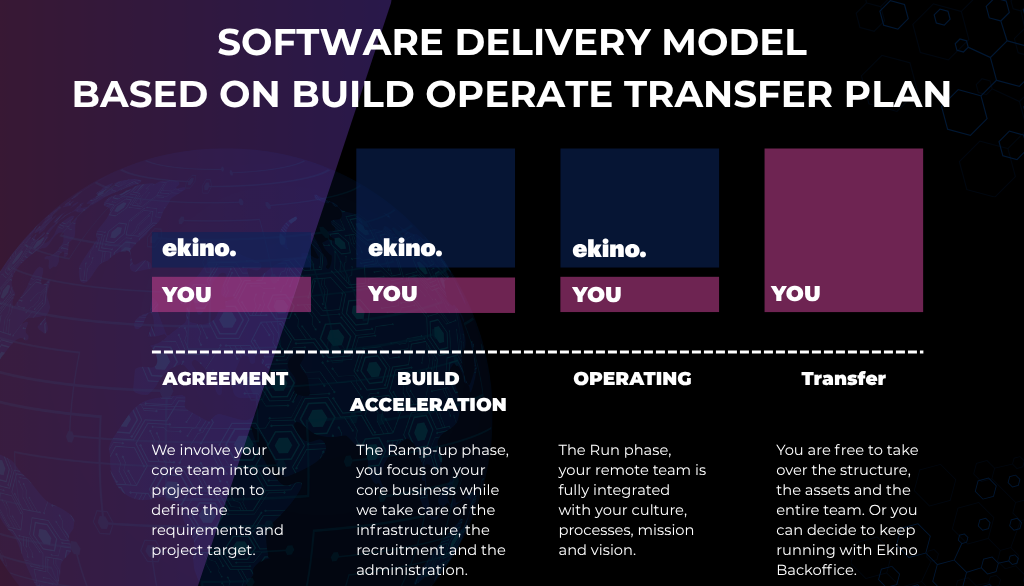
As the name indicates, a B.O.T plan contains 3 distinct phases. This section will introduce each phase in detail, as well as how ekino Vietnam can support you throughout your project by implementing B.O.T.
Phase 1: BUILD
The client organization first defines its business needs, objectives, goals, KPIs, expectations in terms of team size, skillsets required, etc. clearly with the outsourcing service provider.
Once the requirements are gathered and understood, the B.O.T Company will set-up a dedicated office space under a new legal entity, start the hiring process, secure the equipment, technologies, other key infrastructural aspects needed to execute the project within a designated budget. Recruitment can be complicated, and the right outsourcing partner can make a world of difference.
In order to put together the right team with the desired skillsets, Ekino Vietnam shortlists the candidates, who are then vetted by the clients. The clients can also choose to be fully involved in the hiring process. Though brilliant, the offshore team will be hired on the basis of the culture of the client organization to ensure cohesion with the existing onshore team. Ekino Vietnam builds 20 to 120 member teams for its clients with complete transparency on the cost.
Phase 2: OPERATE
This next phase is extremely critical to accomplish project goals and meet deadlines without deviating from the budget.
The right outsourcing partner will manage all the administration and operations with due diligence. The client is kept updated on the status of the project and progress made through regular meetings.
Considering the rapid technological advancements, coupled with unique logistical challenges (time zones and geographical distance), it becomes essential that the offshore and onshore project leads maintain daily, weekly, monthly and quarterly communication.
Additionally, the standard operating procedures shared by the client during the ‘Build’ phase are integrated into the fabric of the new entity. This ensures that the customer’s culture, process and brand remain entrenched in the subsidiary as well.
It’s important to realize that a world-class team is an asset, but they have to be invested in the company for the long-term. Otherwise, it wastes knowledge, time and training effort.
Ekino Vietnam manages all the day-to-day project-related operations in alignment with the project needs and the client expectations. Considering the key role outsourcing employees play, we understand that employee retention is key to completing the project in budget.
Phase 3: TRANSFER
After the term of the project, the client can choose to get full legal control of the offshore subsidiary.
At this point, Ekino Vietnam will transfer 100% of the operation, intellectual property, data, assets and the team along with local business license to the client.
When does B.O.T make sense?
Many organizations have not fully explored the possibilities offshoring and outsourcing can offer. The reasons are twofold:
- Organizations tend to believe that traditional manual-intensive technical or support work is outsourced to offshore countries where technical talent is cheaper than domestic markets. Although this may have been true, outsourcing service providers today are claiming a much higher role in the value chain by providing innovative, strategic and revenue generating solutions to their clients.
- Organizations believe that their contract options are limited to staff augmentation or dedicated team model. While these arrangements are a great fit for many businesses, some may find them difficult to adopt due to corporate regulations related to intellectual property, and data protection, as well as expectations for quality of deliverables, on-time delivery, employee retention and accountability. These expectations can only be met with increased control and governance over the operations of the outsourced entity.
For large-scale and long-term projects, where stakes are high, companies prefer a more hands-on engagement model to the traditional staff augmentation or dedicated team model. A B.O.T model allows the client organization to establish their own business in the local market, a more involved cooperation with the B.O.T service provider and managing resources firsthand.
What are the benefits of B.O.T?
Besides these advantages, a B.O.T plan provides other benefits which are explained below.
Employee Productivity & Job Satisfaction:
Hiring within a foreign subsidiary means that the team will not be working on any other projects but will be fully committed to that of the new entity. This allows the employees to be more productive without being stretched too thin which further contributes towards job satisfaction.
Development of Internal Capabilities:
B.O.T model is an excellent way for organizations to build their internal capabilities while creating and securing value and achieving their goals.
Market Entry Strategy:
Organizations that want to enter foreign markets equipped with new skills or more valuable service offering can benefit greatly through this model.
Go-to Market Speed:
In the technological rat race, the fast and first movers enjoy considerable advantage. That is precisely what the B.O.T model enables.
Focus on Strategic Activities:
The client organization can focus on strategic growth or core functions rather than administrative intricacies of operating a foreign subsidiary. A good outsourcing partner makes the new entity integration with the original business extremely smooth and easy.
No Cultural and Legal hassles:
B.O.T also ensures faster grasp over the local cultural aspects as well as legalities which tend to delay the new entity set-up process if dealt with first-hand by the client. In-depth know-how by the outsourcing partner makes the execution that much simpler and hassle-free.
Cost Reduction:
One of the top most reasons offshore and outsource centers has become so popular is on account of the reduced rents, salaries, administrative charges, and other costs associated with setting up and operating a foreign subsidiary.
Conclusion
Outsourcing can offer strategic advantages to organizations seeking operational and digital transformation. However, its success ultimately depends on the organization’s needs and an awareness of its limitations.
Hopefully, this article has helped you to understand the advantages of doing Software Development Outsourcing with a B.O.T plan.
Contact us if you want to know more about how we accompany our customers with B.O.T project.