Service Design
Service Design Readiness Checklist

With the growing need for efficient developing time and consistent user experiences across digital touchpoints in application design, organizations have relied on establishing a service design infrastructure to ensure both. Before doing so, however, they must tackle a serious challenge: how do you ensure readiness before committing significant resources to design transformation?
Service design can be a valuable tool, but implementing it requires considerable time, budget, and organizational alignment. Without a structured readiness framework, teams risk building a system that fails to deliver value or gain adoption.
This checklist is built on practical experience implementing service design at scale, identifying the critical factors that determine whether a service design initiative will succeed or stagnate. In particular, it is framed around three specific, concrete dimensions as evaluation criteria for teams to practically monitor the usability of their established service design infrastructure.
Laying the Groundwork: What is a Service Design Infrastructure?
A service design infrastructure is a shared foundation for building consistent experiences across products and services. This typically manifests as centralized documentation containing reusable components, interaction patterns, content guidelines, and implementation standards.
The user base for service design systems spans multiple roles: designers, developers, product owners, marketing leads, and external partners may require access to these shared resources. This system provides both visual assets for designers working in tools like Figma or Sketch, and coded components for developers working in frameworks such as React or Angular. Given its cross-functional dependency, organizational readiness is particularly crucial.
Weighing the Options: Core Benefits and Hidden Costs
Service design infrastructure delivers value through three primary ways:
- Establishing visual and functional consistency across different products within the same organization.
- Accelerating production through standardized, reusable components.
- Improving knowledge transfer by creating a single source of truth accessible to all types of stakeholders.
Major technology companies including Google, Apple, Facebook, Amazon, and Microsoft have established their own comprehensive service design systems; Google’s Material Design in particular being widely recognized. Its use is not limited to the tech sector, however: organizations operating in insurance (example: the French company MAIF), banking (example: the France-based BPCE group), and public services in countries like the UK have followed suit, implementing their own frameworks to manage growing application portfolios.
Still, the task of constructing and maintaining a service design infrastructure is too often underestimated. Some primary challenges that need to be accounted for include:
- Defining an appropriate governance model with dedicated team resources to ensure sustainability.
- Establishing durable collaboration between technical, product, and design teams to drive engagement.
- Anticipating evolution requirements to prevent obsolescence over time.
When these factors are not addressed from the beginning, the result is often an incomplete system that remains unused, unmaintained, and eventually abandoned.
A service design infrastructure functions as a living system that needs continuous care and feeding to deliver value. It must grow, become more educated and intelligent, and evolve into a valuable companion for all users.
Building the Framework: Three Dimensions to Evaluate
To ensure a healthy and effective service design infrastructure, organizations should monitor its operation using a readiness framework focusing on these three dimensions from the beginning: adoption, progression, and performance.
Each dimension is briefly explained below.
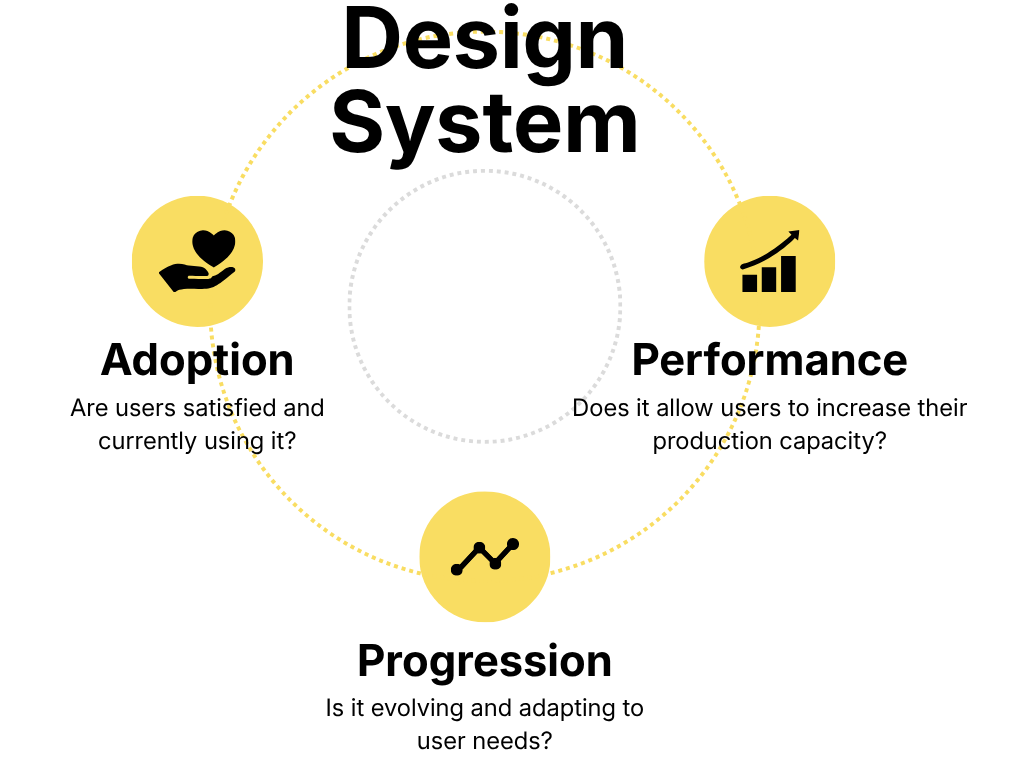
Adoption Readiness
Adoption readiness examines whether users are satisfied with the service design infrastructure and actively consuming it. While performance metrics often receive the most attention, adoption tracking is equally essential. Service design initiatives can fail despite strong technical implementation if adoption is neglected.
In other words, ask yourself: “Is the design system infrastructure actually helpful to users? How responsive is the process for requesting components?”
When measuring the degree of adoption, teams can track specific metrics like which components are most commonly used or how often the service design system is visited. Tools like Figma allow for component tracking, but teams can also directly place tags on apps in production. A given app’s development sometimes has no need for the system due to the app’s use context and characteristics.
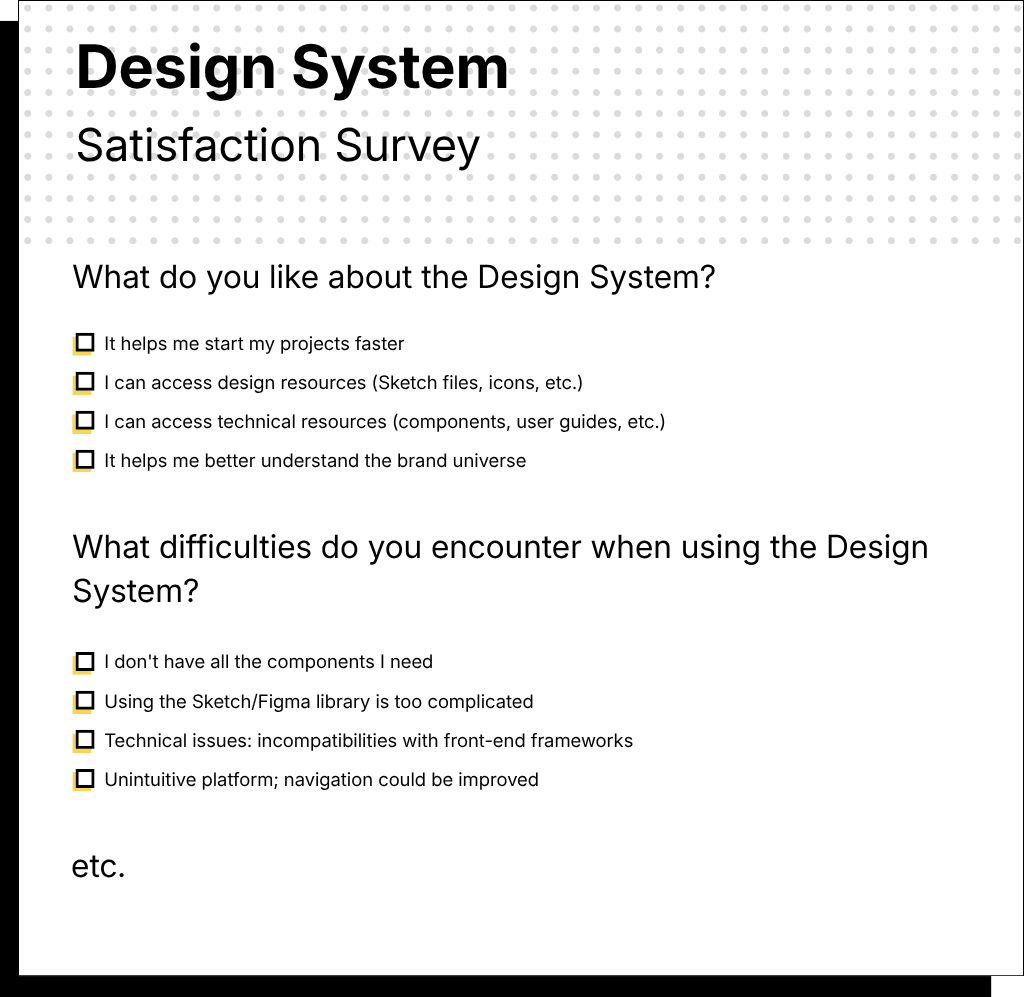
Besides this, other methods like periodic interviews and feedback forms provide a more qualitative look into where the system is working or failing on an individual user level. By pairing quantitative with qualitative tracking, the user adoption and evaluation process can become more thorough.
Progression Readiness
Progression readiness ensures that the service design infrastructure evolves constantly to meet team needs. This requires monitoring of construction and maintenance activities.
Metrics like the creation rate of new components, their development time, and documentation completeness can indicate the infrastructure’s robustness. Documentation needs to account for both “graphical” components used by designers in Figma or Sketch, as well as “developed” ones that developers use in technologies including React and Angular.
Key progression indicators include the average time to design a simple component, number of consuming applications, number of contributions (new component requests) per month and year-over-year progression, and number of bugs generated and processed. Progression can be measured using built-in tracking systems in Figma, but a dedicated tracking board is ultimately necessary.
Performance Readiness
Performance readiness addresses whether the service design infrastructure reduces production costs by enabling designers and developers to reuse standardized components without creating them from scratch. Since the implementation process itself carries a significant cost, possibly including an entire team of maintenance, the investment must be justified by demonstrating production savings.
The primary question is whether design and development production time is reduced. Other important factors include whether bug counts have decreased and production quality has increased. Since a design system infrastructure gathers all resources in one place, shorter onboarding time for new members can also be seen as a sign of its efficacy.
One simple, if blunt, way to measure design system performance is to compare the time spent with and without the infrastructure. For example, see how much time is spent on a screen designing all components from scratch as opposed to the same screen with pre-designed available components.
Final Consideration: Contextual Adaptation
Service design contexts vary significantly. The infrastructure may be used by numerous applications, different types of end users, developed in multiple technologies, and used across different devices. Responses to these contextual questions should orient the types of indicators to track.
At launch, understanding the context, users, and their needs is essential for determining relevant indicators. Measuring adoption is key, and while it can take different formats adapted to context, organizations must dedicate resources from the beginning to design a system that will be useful to all and ensure it remains so throughout its lifespan.
The readiness framework assesses whether an organization has the governance, collaboration, and evolution capabilities required to sustain service design infrastructure. By focusing on adoption, progression, and performance before and during implementation, product and CX leads can identify possible oversights and take action while course correction is still possible.