Software Development
Reducing Costs with Universal Apps and Shared Design Systems

The current digital environment is one where an organization’s technology decision can have a direct impact on its competitiveness. Take this commonly asked question: how should a company manage its online presence across different platforms? Some companies typically opt for the traditional approach, which is to build and maintain separate, native applications for each ecosystem.
While this ensures a tailored experience, it also introduces significant operational challenges. Maintaining distinct codebases requires specialized, platform-specific development teams, leading to duplicated efforts and increased overhead. This complexity further extends to maintenance, where every update or bug fix must be implemented and tested multiple times.
As companies eventually find, the result is often slower innovation cycles and higher long-term costs. This is where an alternative architectural approach should be considered, in particular a more unified structure centered on Universal Apps.
This article explores what a Universal Apps-based approach is, what its advantages are compared to the fragmented multi-platform strategy, and how companies can leverage Universal Apps to streamline their current architecture for enhanced performance and responsiveness.
The Universal App Solution: A Single Codebase for All Platforms
Universal Apps refer to applications designed from a single codebase, capable of running natively across multiple platforms, including web, iOS, and Android. While previously limited to applications that work well on both iPhone and iPad, Universal Apps have expanded to include other devices like TVs, PCs, and more.
Compared to utilizing separate applications, this unified model offers three notable strategic advantages for organizations:
- Simplified Maintenance: A correction or a new feature benefits all platforms simultaneously, ensuring a consistent user experience.
- Reduced Development Costs: Instead of separate, platform-specific development teams, only a single team with common web technology skills (like TypeScript) is needed to build for all targets.
- Accelerated Time-to-Market: A unified development process allows new features and updates to be launched more quickly, across all platforms.
To effectively implement Universal Apps, however, teams need to start from a sufficient technological foundation. In this respect, modern frameworks like React Native, combined with SDKs like Expo, become essential elements of this strategy.
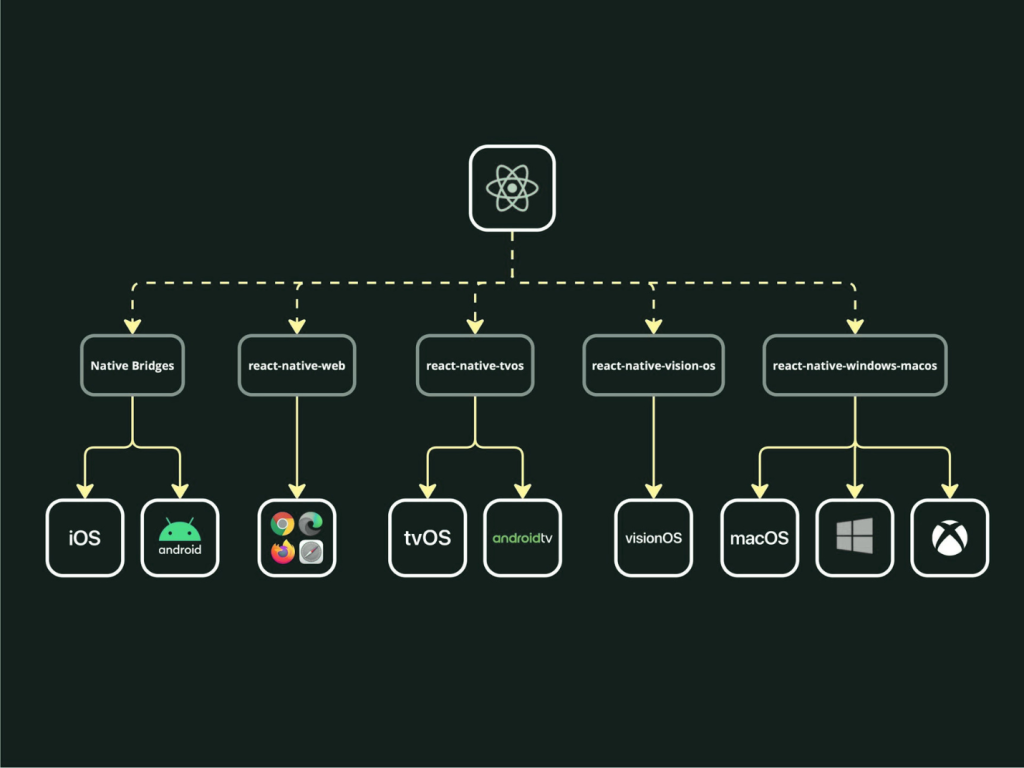
React Native and Expo: The Essential Building Blocks
React Native is an open-source framework for software development that is currently in use and trusted by both established tech companies (Microsoft, Amazon, etc.) and up-and-coming digital platforms (Discord, Coinbase, etc.) alike. It enables developers to create native mobile apps for iOS and Android with TypeScript, a popular programming language.
Expo, built from React Native, is an SDK that allows teams to further streamline development using its dynamic tools, while concealing platform-specific complexities like codes and features. Its greatest strength is the ability to share up to 90% of an application’s codes between mobile and web versions. This consistency does not mean rigidity: the other 10% of the codebase can still be modified to suit each environment’s specific requirements.
The advantages of building a single codebase with React Native and Expo are extensive. In terms of manpower, teams can significantly cut down the necessary workload since the same code will work on most operating systems and devices. Recruiting and training similarly become more straightforward: organizations now only need to focus on talents with sufficient knowledge in TypeScript to build for all platforms.
Benefits in scale and speed are also guaranteed. A consistent codebase also makes it easier to update new fixes or features across all platforms, while allowing for greater scalability towards new platforms by utilizing specific “bridges”. In large-scale projects, the code can even be reformatted in “monorepo”, allowing apps with common elements to be managed simultaneously within a coherent and scalable structure.
Development can be further expedited thanks to functions like Expo Go and Fast Refresh, which lets teams see changes on test devices in real time. Faster development means faster app and feature launches to the public, an important way to maintain the organization’s foothold in the market.
Optimizing Deployment Management with Expo Application Services
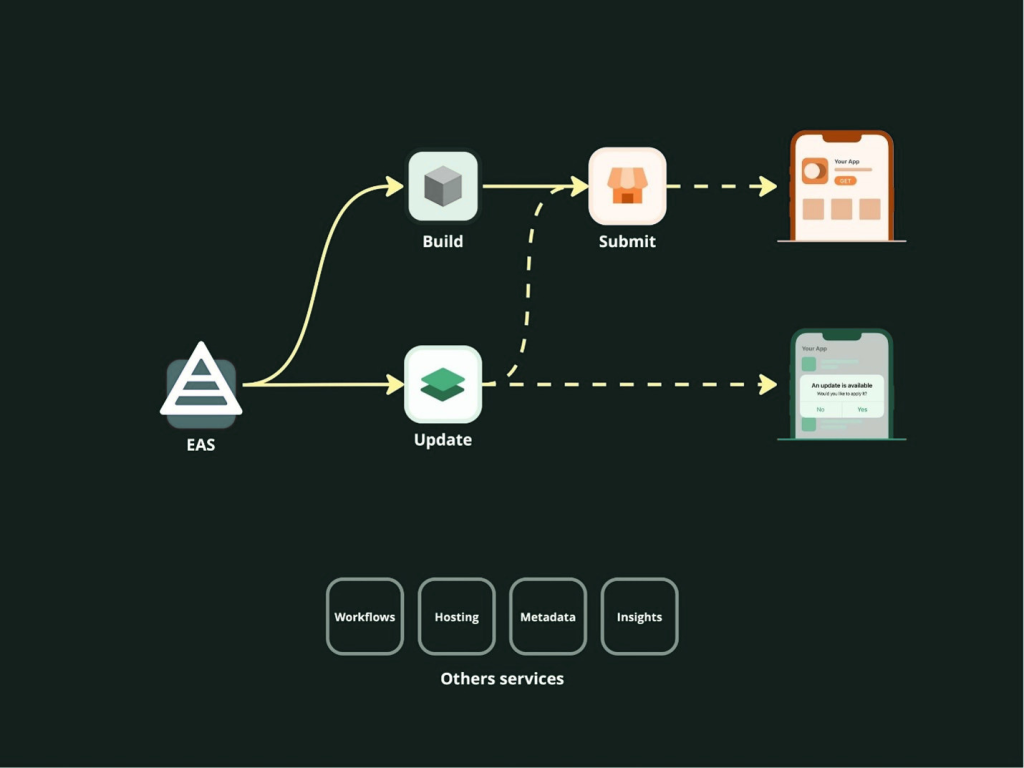
To make the most out of the Expo and Native React foundation during the deployment phase, organizations can leverage Expo Application Services (EAS). As one of the tools available for Expo and Native React apps, they provide several cloud services to streamline the deployment process. In particular:
- EAS Build lets teams compile iOS and Android applications in the Cloud without requiring a Mac
- EAS Submit enables teams to partly automate the submission process to application marketplaces such as App Store and Play Store
- EAS Update provides direct fixes or minor improvements to users, avoiding delays caused by store validation with OTA (Over-The-Air) updates
EAS and Expo are powerful means of enhancing the production cycle, from building the codebase to deploying the final product. They allow teams to minimize complexity, optimize their workflow, and speed up production releases. Best of all, many of these tools can be utilized right away without incurring additional fees.
Still, this strategy only solves one part of the puzzle. The primary challenge for Universal Apps has shifted from code duplication to user experience design. How does an organization ensure that a single application provides an optimal interface everywhere, from a mobile touchscreen to desktop browser?
Bridging Platform Gaps with a Shared Design System
This is where a shared design system becomes essential. A robust design system acts as the single source of truth for all user interface components, patterns, and guidelines. When building Universal Apps, the design system ensures the following:
- Maintained Consistency: All platforms draw from the same library of pre-approved UI components, guaranteeing brand and UX consistency.
- Managed Platform-Specific Adaptations: While the core logic is shared, the design system can define rules for how components adapt to each platform. This allows for specific adjustments, such as optimizing for search engines on the web or accommodating touch-based navigation on mobile, without creating architectural fragmentation.
- Streamlined Collaboration: It creates a common language between design and development teams, ensuring that the interface is engineered to be effective and adaptable from the project’s beginning.
Establishing a shared design system can lead to a more consistent, polished and accessible user interface across mobile, tablet, and web devices. This encourages user adoption and retention, as they can trust that the application will work as intended regardless of the device.
While cross-department collaboration might have faced logistical challenges in the past, the shared design system today is being supported by various tools such as Tamagui and Gluestack. These useful resources are growing and continuing to assist close engagements between design and development teams.
How Universal Apps Address Performance
One more issue to consider in multi-platform approaches is performance. Modern Universal App frameworks built on Expo and React Native can address this through advanced architectural features.
On mobile, new architectures allow JavaScript code to interact directly and efficiently with native system components, resulting in fluid, responsive applications with performance comparable to natively developed software. On the web, these frameworks can integrate with technologies that enable Server-Side Rendering (SSR). This improves initial load times and Search Engine Optimization (SEO), delivering a high-quality user experience that adapts seamlessly to various screen sizes.
A Universal App approach supports a smooth, bug-free experience across smartphone, tablet, and desktop. This is essential to maintaining positive user interaction as well as the company’s digital presence.
Key Takeaways: A Strategic Framework for Efficiency and Growth
An architectural rethinking may seem daunting. However, shifting towards a Universal Apps approach brings real, quantifiable results:
- Time-to-market reduced by 30%
- Development costs slashed by up to 40%
- Further expansion enabled (e.g. code share React Native primitives and general JavaScript logic when building apps for Out of Tree platforms like Apple TV and Mac)
- Responsiveness increased (e.g. publish OTA updates using EAS Update without disrupting app store submissions)
For IT directors, the combination of Universal Apps and shared design systems offers a valuable strategic framework. Rather than managing multiple native applications, which creates operational inefficiencies and high costs, a unified codebase lets organizations reduce redundant development work, simplify maintenance, and accelerate the delivery of new features.
This new approach allows a business to reach its audience wherever they are, without multiplying costs or compromising the user experience. It transforms the development lifecycle from a series of fragmented, platform-specific projects into a single, cohesive, and efficient operation designed for agile and sustainable growth.