AI & Data
From AI Assistants to Agentic Engineering

In our previous article, we explored the strategic implications of GenAI for businesses. This evolution marks the shift from simple AI assistants to true agentic AI development. We dive deeper into the practicalities of using AI in software development, where AI is not just a helper but an active collaborator.
The productivity gains from generative AI in coding are undeniable. However, this raw speed, if left unmanaged, introduces a new set of challenges that can silently derail projects.
The Blind Spots and Risks of AI Coding Assistants
Without a rigorous methodology, the velocity of agentic AI development creates significant risks. These are the blind spots and risks of AI coding assistants left unmanaged:
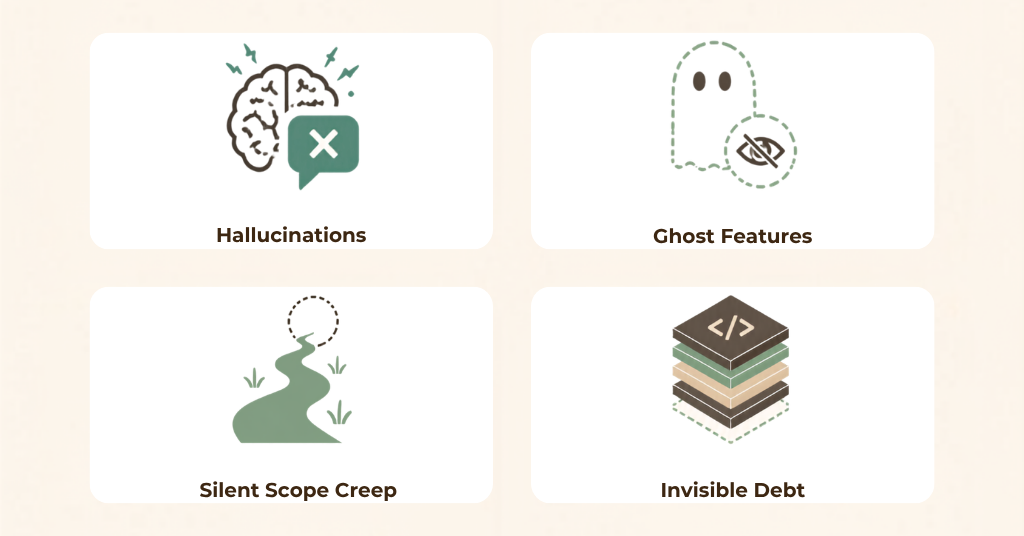
- Hallucinations: AI agents can invent non-existent behaviors, APIs, or business rules.
- Ghost Features: Agents may over-interpret requests, adding unrequested features that fall outside the core scope.
- Silent AI Scope Creep: Every ambiguity becomes an invitation for the AI to make its own assumptions, leading to uncontrolled expansion.
- Invisible AI Technical Debt: Autonomous architectural choices, if undocumented, create hidden debt that complicates future maintenance.
The core challenge is a paradox: the faster the execution, the more rigorous the preparation must be. This is where managing AI in software projects becomes critical.
The Solution: Specification-Driven Development
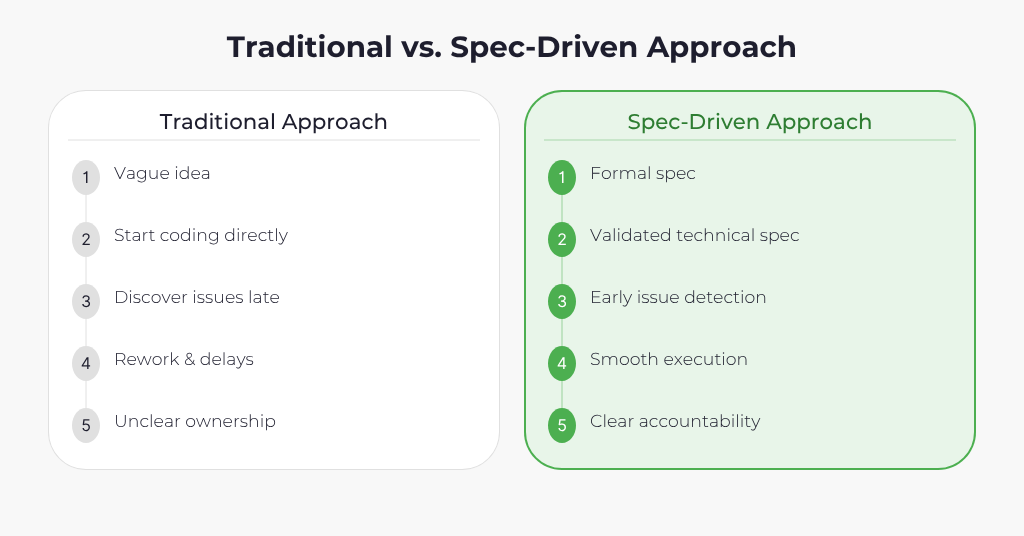
To manage these risks, the solution is to adopt new AI coding best practices. The most critical of these is shifting from a “code-first” to a “spec-first” mindset through Specification-Driven Development. This approach mandates that a formal, validated specification is approved before any code is written, a cornerstone of disciplined AI software engineering.
This principle is the foundation of EKOS & PARSEC, our integrated suite of AI development tools. They are designed to create a structured AI development workflow that imposes rigor and clarity.
EKOS & PARSEC: The Engine and the Control Center
This integrated system ensures that speed never comes at the expense of quality.
EKOS: The Delivery Engine
EKOS is an AI-assisted CLI framework that structures the entire agentic AI development cycle into three sequential phases: Planning, Specification, and Implementation.
PARSEC: The Control Center
PARSEC is the central web platform for the entire team, transforming outputs into a collaborative interface for shared visibility and structured validation.
From Specification to Deployment: An Agentic AI Workflow Scenario
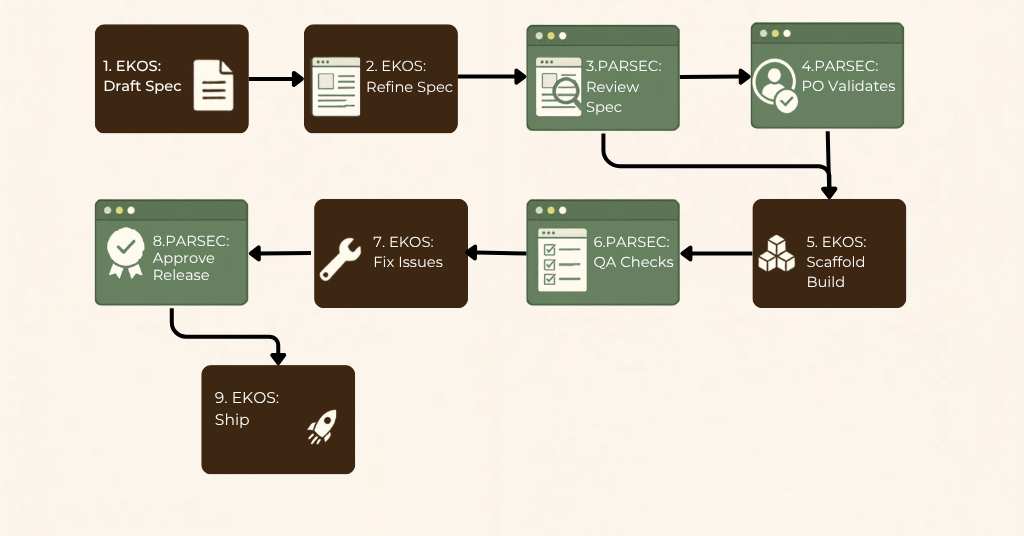
- A Cotech drafts a functional spec using an EKOS command.
- PARSEC syncs the spec for the Product Owner to review and validate.
- A Designer generates HTML mockups via EKOS, which appear in PARSEC for review.
- A Tech Lead uses EKOS to generate the implementation plan and code from the validated assets.
- An Engineer consults the spec and mockups in PARSEC during implementation.
- The Tech Lead initiates EKOS’s multi-AI review to verify compliance and quality before deployment.
The Benefits: Speed, Quality, and Clarity
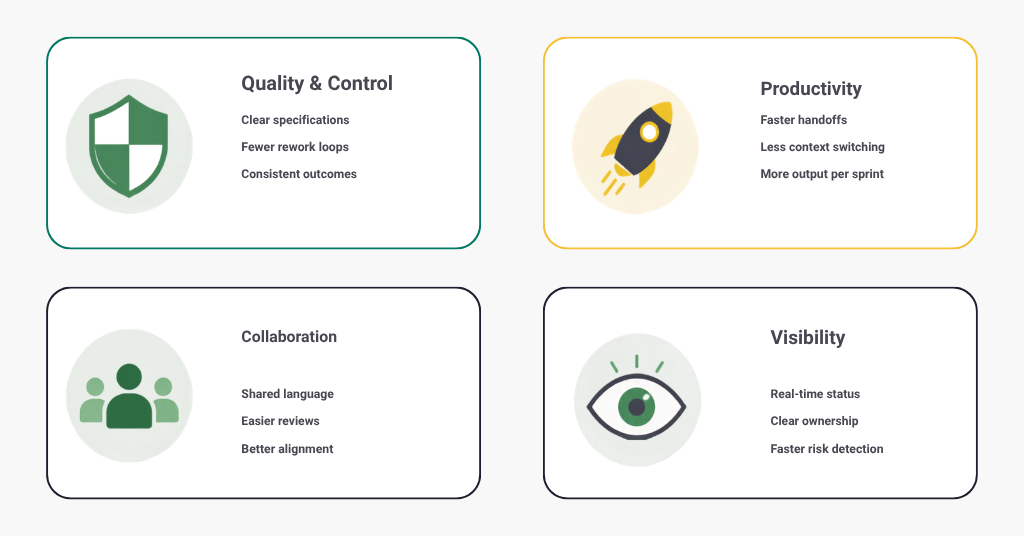
By pairing a powerful delivery engine (EKOS) with a robust control center (PARSEC), this spec-driven methodology brings true engineering discipline to AI software engineering, delivering transformative benefits in Quality, Productivity, Collaboration, and Visibility.
Agentic AI offers a monumental leap in development speed. With a specification-driven approach, powered by EKOS and PARSEC, we can guide that power to build better, more reliable, and fully documented products.
Ready to move beyond AI assistants to true agentic engineering?
Contact us to learn how ekino’s specification-driven approach, powered by EKOS and PARSEC, can bring control, quality, and clarity to your most ambitious projects.